
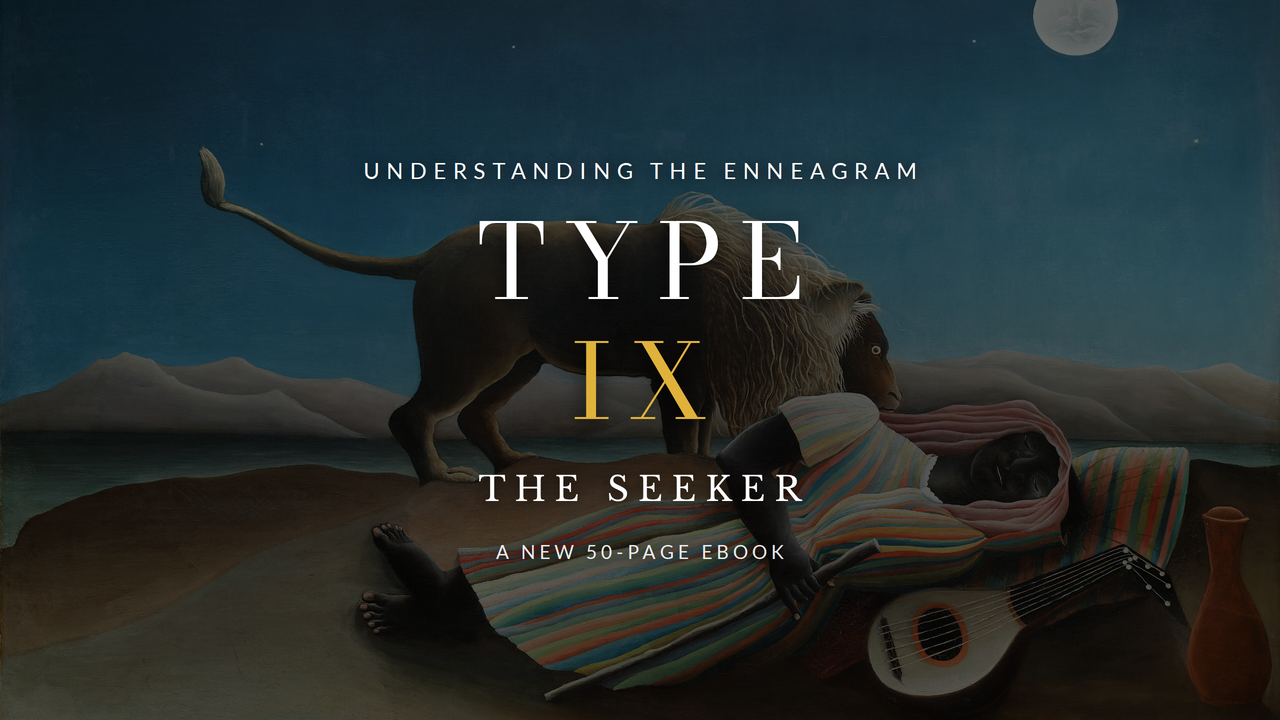
eBook · The Understanding Type series
The type we let off easy.
Of all nine types the Nine received the gentlest treatment in the literature, and the gentleness has probably done more damage than the harshness done to any of the others.
Read almost any other type and what the structure costs the person running it is stated plainly, sometimes brutally. The unhealthy end of Nine, by contrast, tends to sound mild, a little laziness, a few things neglected, some passive aggression around the edges. What that framing misses is that the calm is neither restful nor free, since being easygoing and conflict-free is something Nines generally work at more or less constantly, without much awareness of the expenditure.
The booklet gives the Nine the same unsentimental treatment any other type would get, which means it is not another portrait of the sweet, sleepy peacemaker. A fair amount of what is in it came from Nines who trusted us enough to stop being pleasant, which may be the only condition under which this type says anything accurate about itself.
Read what is insideWhat it holds
Inside the booklet.
The core structure
Why sloth has almost nothing to do with laziness, describing instead a refusal of insight aimed at the self, and why a Nine exerts more force on a room than people expect.
Recognizing a Nine
The vacant eye that Naranjo and Ichazo both noticed, and then disagreed about, the saga as the talk style, and the false flag the ego assembles for some other type.
The three subtypes
Appetite and the routine that anesthetizes, the room-tracking of the Social Nine, and the merging of the Sexual Nine, three energies that can read as unrelated types.
Working with Nines
The three things that matter more than everything else, including why declining to accept I do not know as a final answer is among the more loving things available to you.
The growth path
The one type whose work runs opposite to everyone else’s, since a Nine has to individuate more rather than less, and the practices that tend to feel wrong at first.
$40
A digital booklet, yours to keep.
It is the second booklet in a type-by-type series. It runs a little longer than the Six, at fifty pages and nine paintings. It was written for coaches who lose the thread of a session and only afterward suspect why, and for Nines who have typed themselves as a Five or a Seven or a Three and keep circling back to Nine and away again, a pattern that is (somewhat unfairly to the rest of the system) among the more reliable signals there is.
Get the booklet