
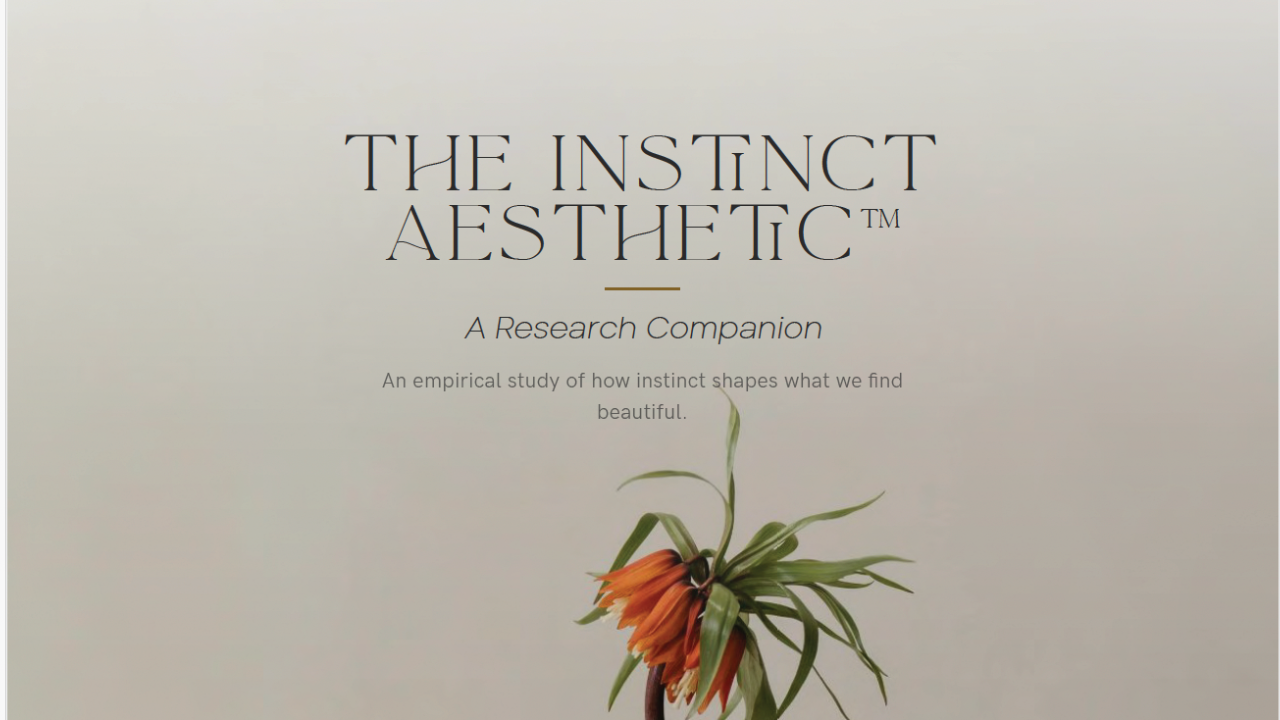
Research companion
The evidence underneath the aesthetic.
The Instinct Aesthetic began as a question about why two people with similar taste, similar budgets, and similar training in what is supposed to be beautiful will nonetheless build rooms that feel nothing alike, and the companion is where that question finally got written down with the study attached, rather than left standing as a claim about the eye that people were free to take or leave.
The research ran at the University of Oklahoma between October 2025 and April 2026 under IRB approval, and it is reproduced here in full. Around it sit the three instinctual drives, the three aesthetic registers each drive tends to produce, and the seasonal layer that opens those three into twelve distinct profiles. Of the 167 participants, 76.7 percent chose the register their dominant instinct predicted, a concordance stronger than I expected going in and weaker than anyone selling certainty would want.
It was written for whoever wants the method and the numbers rather than only the mood board, an audience that tends to run smaller than the aesthetic attracts and rather more demanding.
Read what is insideWhat it holds
Inside the companion.
The three drives
The self-preservation, social, and sexual instincts work as survival systems, organizing attention well beneath the level of taste and more often than not long before anyone acquires a vocabulary for what they like.
The three registers
Sensual, Communal, and Magnetic are the aesthetic worlds each drive produces, described closely enough that most readers recognize their own (and occasionally their mother’s) before the section ends.
The research
The full sample and the instrument used, the concordance figure and a plain account of what the study does not establish.
The twelve profiles
The full set arrives here, each of the four seasons crossed with each of the three registers, and Sensual Autumn worked through as a complete visual world.
$10
A digital companion, yours to keep.
The companion is priced low because it exists to make the research legible, rather than to stand as a product in its own right. Anyone inclined to argue with the method should perhaps be able to see it first, whether or not they end up persuaded by what it shows.
Get the companion